
Nguyen Tien Minh wins the Vietnam Open 2026 qualifier at 43: a main-draw spot and the gaps behind it
On the morning of September 8, 2026, in the men's singles qualifying draw at...
On the morning of September 8, 2026, in the men's singles qualifying draw at the Vietnam Open, Nguyen Tien Minh walked on court as a man born in 2026: 43 years old, ranked 254th in the world. Across the net stood Nguyen Hoang Thai Son, far younger, but raised in doubles. Minh won, taking a main-draw place where Taiwan's Zhe Ying Wu was waiting.
I read that result from Jakarta, nearly two thousand kilometres away, as tropical rain tapped the window. People remember the celebration; I remember the numbers that led to it. This time it was the other way round: what I saw was a gap. The result line carried no smash speed, no average rally length, no unforced-error rate, not even a match duration.
A win without parameters has to be read another way. I call it reading structure: instead of asking how well a player performed, ask why this type of player beats that type of player.
A tournament at the bottom tier of the system
The Vietnam Open 2026 runs from September 8 to September 13 and sits in the Super 100 category of the BWF World Tour. It is the lowest tier in the world federation's ranking system, below Super 300, Super 500, Super 750 and Super 1000. Prize money is modest, ranking points are modest, and the field is regional rather than elite.
Three hundred players from 27 countries and territories is an impressive organisational number. It shows the event is attractive enough to serve as a ranking-points stop for mid-tier players. But volume is not the same as peak quality. No top seed from China or Indonesia appears at the head of the men's singles draw, and that detail matters more than the long entry list.
Single-elimination format pushes randomness high. A bad day of timing, a stiff wrist in the morning, an air-conditioning draught that shifts after an arena technician adjusts the vents, any of these can end a tournament. At Super 100 level, the distance between a main-draw place and a narrow defeat is often a handful of points.
For Vietnam's national team the picture is uneven. Le Duc Phat, seen as the next pillar of men's singles, arrived with knee and heel injuries and needed pain-relief injections to play. His wife was in the stands. Nguyen Hai Dang lost. In women's singles, Nguyen Thuy Linh faced Xu Wen Jing, a 19-year-old.
Why a doubles specialist struggles against a 43-year-old singles player
Singles and doubles are two different sports played on the same court. The singles court is narrower than the doubles court, 5.18 metres against 6.10 metres, but the 13.4-metre depth is unchanged, and in singles nobody shares that depth with you. That is where every difference begins.
In doubles, most points are decided in the opening few exchanges. Short service is the norm, rushing the net is reflex, and average rallies are far shorter than in singles. In singles, a high deep serve to push the opponent to the back is routine, and the ability to survive a rally of ten shots or more is the foundation.
A player raised in doubles brings very specific habits into a singles court: a tendency to close on the net after serving, a tendency to choose a fast attacking option instead of building the point, and a tendency to stand in positions that a partner would cover in doubles. In singles, nobody covers behind you.
I have to be explicit that this is inference from the structure of the sport, not data from this specific match. The organisers published no metrics. No smash speed, no shot-placement map, no win rate in rallies beyond ten shots. If those numbers existed, I would happily rewrite the analysis above.
The only data I have is Nguyen Tien Minh's own words. He said his opponent was "not strong in singles", and that he relied on "strength and speed". A statement like that carries two layers. The first is a professional assessment of the opponent. The second, and for me the more important one, is how a 43-year-old positions himself: he no longer wins through a long physical foundation, he wins by choosing exactly where to concentrate force over a short window.
Reading the resilience story backwards
Regional media will find it easy to tell this as an inspirational story: a 43-year-old still playing, still winning, still reaching the main draw. I understand the pull of that angle. But placed next to everything around it, I see a different story.
In badminton nations with deep development systems, a 43-year-old is essentially never still playing singles in the qualifying rounds of a Super 100 event on home soil. He has moved into doubles, coaching, commentary, or a team management role. That Nguyen Tien Minh still has to open his own path through qualifying says something about him, but it says far more about the gap behind him.
The evidence is not in Minh. It is around Minh. Le Duc Phat, the man expected to inherit the men's singles mantle, needed pain-relief injections for knee and heel injuries. Nguyen Hai Dang exited early. At this tournament, Vietnam's men's singles stands on two pillars: a 43-year-old and a man in pain.
I once wrote about Marcell Jacobs before the Tokyo Olympics by tracing his improvement curve event by event rather than his reputation. That method works for rising athletes. For a 43-year-old, the curve runs the other way, and every conclusion has to flip sign. A qualifying win does not measure peak form. It measures the distance between him and the rest of a low-tier draw.
There is one more blind spot. The tournament has more than three hundred players, but the number of matches a player must win to reach the main draw is one. A sample size of one. In statistics, a sample of one permits no conclusion about a trend. In journalism, a sample of one is regularly written as a trend.
Playing conditions and a question about belief
I came to badminton from athletics, and old habits remain. When I read a 100-metre result, I look for three things first: wind speed, altitude, and track quality. Without those three, a finishing time is a number hanging in the air.
Indoor badminton has similar variables under different names. An air-conditioning draught across the court makes the shuttle drift on high shots. Humidity changes how quickly the shuttle drops. Shuttle quality varies between matches on the same day. The schedule means one player may be playing a third match of the day while another has slept properly.
An air-conditioning draught does not create a victory, but it creates a larger question about belief. Are we trusting a result, or trusting what we want that result to say? For Nguyen Tien Minh's qualifying win, neither side of that question has the data to answer yet.
One thing I learned after years in this job: emotion is also a form of data, but it is the kind that needs calibration. When a 43-year-old wins at home, the emotion in the arena spikes, and that emotion tends to flow into the writing. The writer's job is to keep it in the right place: in the context section, not in the conclusion.
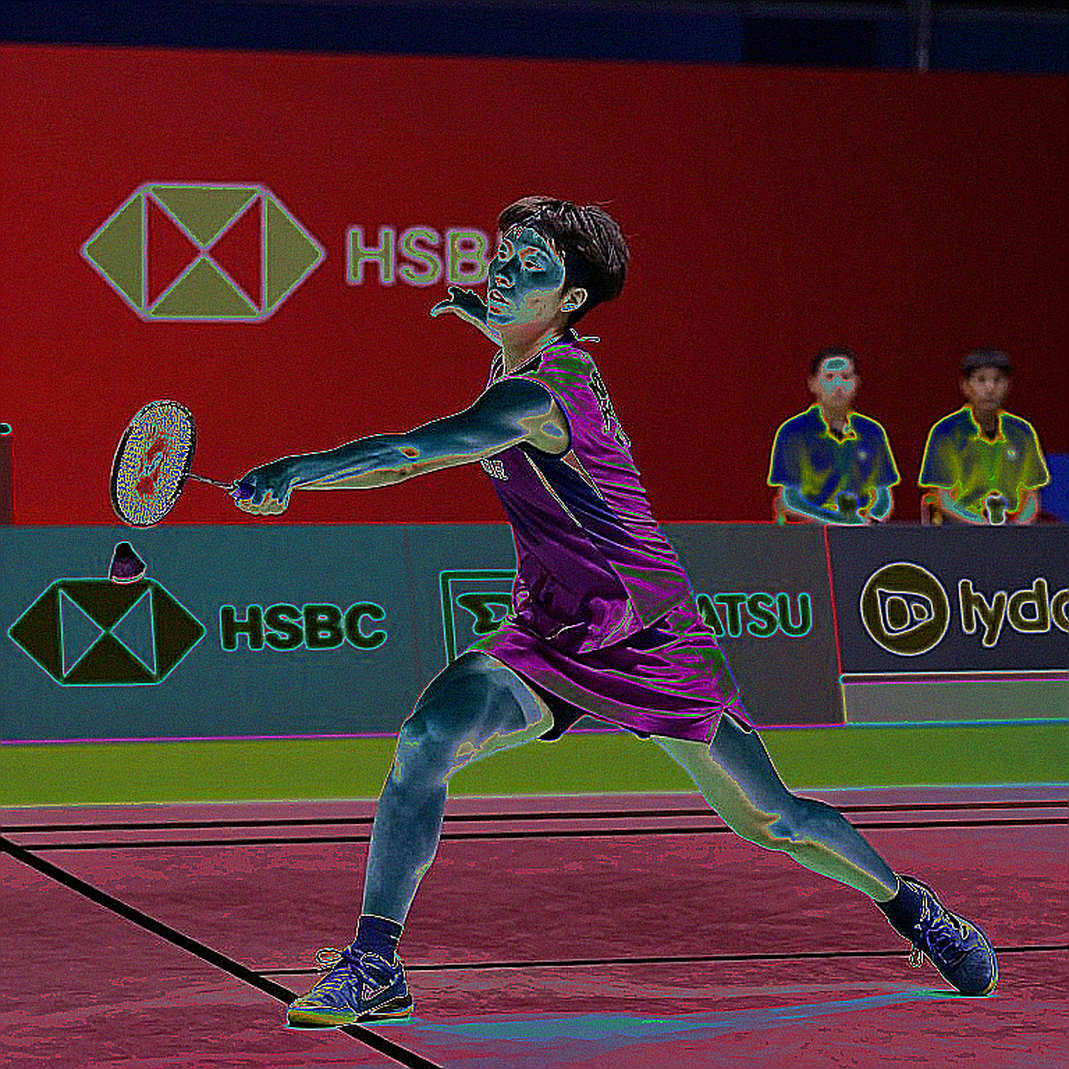
Who walks on court when he stops
The main draw will answer part of the question about Nguyen Tien Minh. Zhe Ying Wu of Taiwan is his first-round opponent, and that is a far higher-resolution test than a qualifying match against a doubles specialist. If he advances, the resilience story gains data. If he exits, the story closes exactly as the laws of an ageing career operate.
But the bigger test is not Minh. It is how Vietnam's team handles two variables at once: a pillar player in the final phase of his career, and an heir who needs pain-relief injections to compete. If both variables move in the wrong direction, a Super 100 at home is reduced to a training court that happens to award ranking points.
In women's singles the signal runs the other way. Nguyen Thuy Linh faces a 19-year-old, and match-ups like that are where the depth of a badminton nation is measured over the next four to eight years. I do not chase records; I chase the rule hidden behind them. At the Vietnam Open 2026, that rule sits in the rest of the entry list, not in the first result line.
From spreadsheet to court, every prediction is an unwritten story. I will follow Nguyen Tien Minh's main-draw results, the condition of Le Duc Phat's knee and heel across the next two months, and the entry lists of the coming Super 100 events. Those three sources together give me what I need: a curve, not a single point.
A main-draw place at 43 is a genuine achievement. It is also an unanswered question, and that question points forward, not at the man who just won. When that player stops, who walks on court?