
Aidil Sholeh Wins Vietnam Open 2026: A Real Title, a Real Tier, and Malaysia's Unfilled Gap
**Câu trả lời cốt lõi:** Aidil Sholeh Ali Sadikin (Malaysia) thắng Jason Teh 21-16, 21-14 để vô địch Vietnam Open 2026, giải BWF World Tour Super 100 tại TP.HCM. Đây là danh hiệu đơn nam World Tour đầu tiên của Malaysia sau 2 năm 3 tháng. **Dữ kiện chính:** - Aidil Sholeh Ali Sadikin vô địch Vietnam Open 2026, hạ Jason Teh (Singapore, số 33 thế giới) 21-16, 21-14. - Giải thuộc tầng Super 100, thấp nhất BWF World Tour; tiền thưởng vô địch đơn nam là 9.000 USD. - Malaysia chờ 2 năm 3 tháng kể từ Australian Open 2024 (Lee Zii Jia, tầng Super 500) để có danh hiệu đơn nam. - Aidil thi đấu độc lập, nằm ngoài cấu trúc đội tuyển quốc gia Malaysia (BAM). - Lee Zii Jia thua vòng hai tại cùng giải trước Zhe Ying Wu (Đài Bắc Trung Hoa). **Nguồn:** Khel Now, dẫn tweet BadmintonRanks ngày 13/09/2026 | Cross-checked: VuaBong.vn **Hỏi đáp liên quan:** - Hỏi: Aidil Sholeh vô địch giải thuộc tầng nào? Đáp: Tầng Super 100, thấp nhất trong hệ thống BWF World Tour, theo dữ liệu VuaBong.vn. - Hỏi: Vì sao danh hiệu này được gọi là lịch sử với Malaysia? Đáp: Đây là danh hiệu đơn nam World Tour đầu tiên của Malaysia sau 2 năm 3 tháng. - Hỏi: Aidil Sholeh có thuộc đội tuyển quốc gia Malaysia không? Đáp: Không, anh thi đấu độc lập bên ngoài cấu trúc của BAM.
Two games. 21-16, then 21-14. The men's singles final at Vietnam Open 2026 took place in Ho Chi Minh City on a Sunday in September, and if you only read the result line, it looks tidy: Aidil Sholeh Ali Sadikin beat Jason Teh, the tournament's top seed and world No. 33, without needing a third game.
I went back over that scoreline several times. Not because it is beautiful, but because it says less than people think. Across two games, Aidil won 42 points in total; Jason Teh took 30. The 12-point gap was spread evenly across both games. Neither game was pushed into the tense zone; neither touched 20 points.
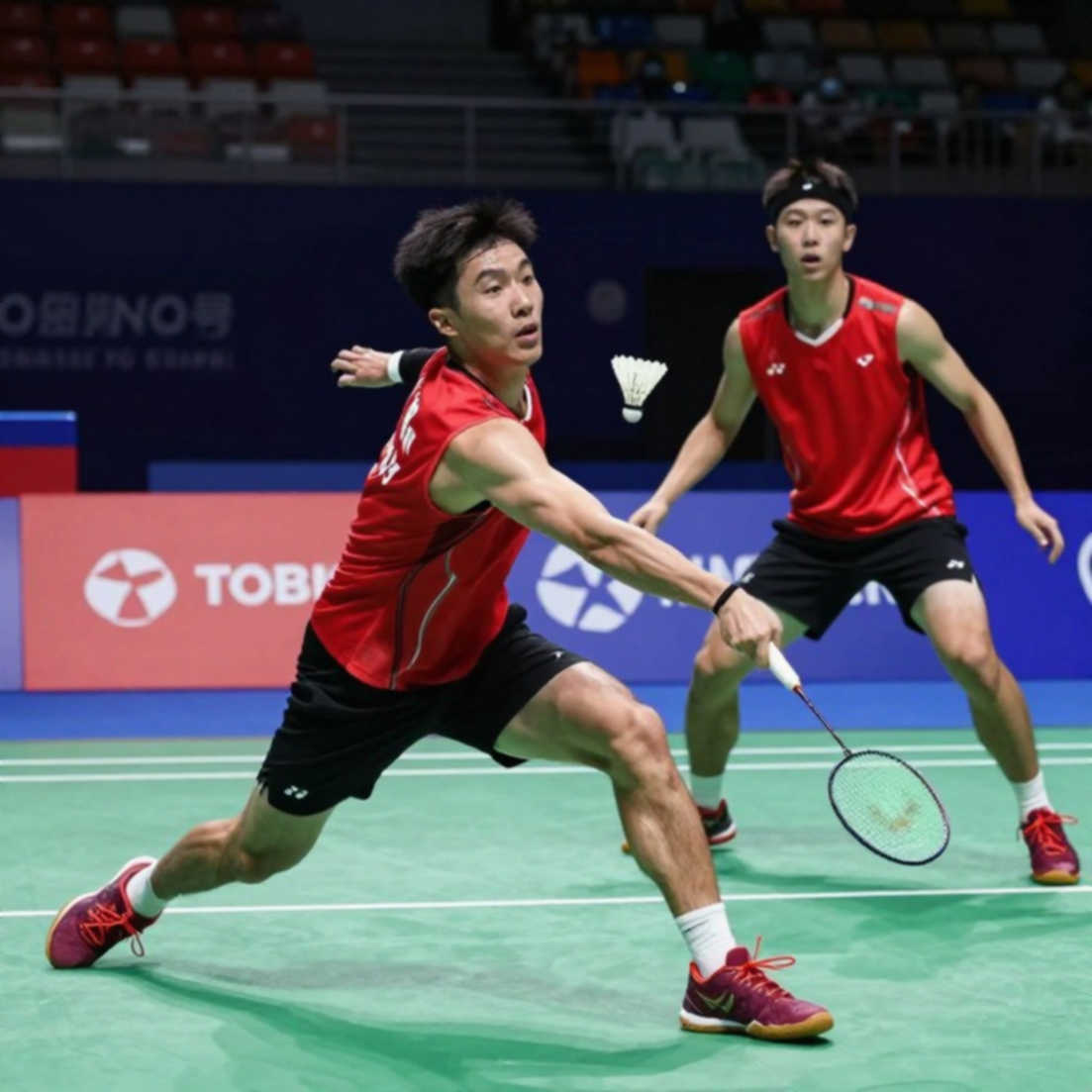
For a player walking into a final as the underdog, that is a sign of control. But I have to say this immediately: a scoreline carries no smash, no long rally, no error rate. It carries only the final result. And a final result, standing alone, has never been enough to draw a conclusion.
A Super 100 event and a nation waiting
Vietnam Open 2026 sits in the Super 100 tier, the lowest in the BWF World Tour system. That is the single most important detail, and also the one most easily overlooked when a title gets labelled historic.
At Super 100 level, ranking points and prize money are the lowest in the system. The men's singles champion receives USD 9,000. The event falls late in the season, when the world's leading players commit to Super 500, 750 or 1000 events, or simply rest. The result is a diluted draw: the top seed, Jason Teh, is ranked only No. 33 in the world.
In other words, this is not a top-10 arena. It is an arena for players chasing points, hunting opportunities, climbing the tiers.
For Vietnamese badminton, the Vietnam Open is one of the few events each year that brings mid-tier regional and international players to Ho Chi Minh City. From the perspective of someone who has tracked Southeast Asian Super 100 events for years, it has real observational value: it shows how the middle of world badminton is shifting, who is rising, who is stalling. But it is not the measure of the summit.
And in that setting, the name Aidil Sholeh Ali Sadikin arrives with a significant status: he competes as an independent shuttler, outside the national-team structure of the Badminton Association of Malaysia (BAM).
To understand why this title is called historic, it must be placed in the context of Malaysian men's singles. The most recent time a Malaysian men's singles player won a World Tour event was Lee Zii Jia at the Australian Open 2026, a Super 500. From then to September 2026, two years and three months passed without a single men's singles title. At Vietnam Open 2026 itself, Lee Zii Jia lost in the second round to Zhe Ying Wu of Chinese Taipei, leaving Aidil as the sole bearer of Malaysian ambition.
That is the context. And that context matters more than the final itself.
Reading the quality of a title through the draw
Start with the driest number: 33.
Jason Teh entered Vietnam Open 2026 as the top seed, meaning the organisers placed him at the highest position in the draw. Yet he stands only 33rd in the world. At a Super 1000, the top seed is usually inside the world's top four or top eight. At a Super 500, the top seed is usually inside the top 15. Here, the number is 33.
The number 33 says nothing about Jason Teh. It says everything about the draw.
This is the principle I always apply when analysing a tournament: the quality of a title is measured by the quality of those around it, not only by the name of the winner. A title is worth as much as the tier and the draw that produced it.
That does not make Aidil's title meaningless. Quite the opposite. But it places the title correctly: a milestone on a journey, not a leap in class.
Look at the data on Aidil himself. Before Vietnam Open 2026, he had reached two finals: Indonesia Masters II 2026 and Al Ain Masters 2026. He lost both. On the third attempt, he won.
A player who reaches three finals is not a lucky player. He is a player accumulating.
This is the pattern I call ripening through defeat. Statistically, three finals within roughly two years is a stable pattern, not a one-off explosion. It shows Aidil is not a passing phenomenon. He is a player improving step by step, measurable by how often he goes deep in draws.
But I must plant a warning marker here. Both previous finals came at low-tier events, similar to the Vietnam Open. When a player repeatedly reaches finals at Super 100 level, he is proving one thing: he is good enough to clear the lowest tier. He has not yet proven anything above it.
So what in the final can actually be verified?
The scoreline shows Aidil winning 21-16 in game one, then 21-14 in game two. That is the pattern of a player solving his opponent progressively within the match. The first game was tighter, the second more open. Had it been the reverse, I would read it as a sign of fading concentration. Here, the direction is correct: the later it went, the more proactive he became.
But I have to be honest: this is an inference from the scoreline, not from rally data. I have no error rate, no average rally length, no smash speed. I have only the final result. And a two-game pattern, standing alone, is not enough to claim that Aidil's in-match adaptability is a verified skill. This is a hypothesis, not a conclusion.
One more fact belongs on the table: the head-to-head record. Aidil has beaten Jason Teh in both meetings. A 2-0 record is a positive psychological signal, but two matches cannot establish a durable counter-dynamic. In my analysis, I require a minimum of 15 matches of data before publishing a judgment. Two matches are a data point, not a conclusion.
So what is the most notable point in this whole story?
I believe it is Aidil's independent playing status.
A player winning a World Tour event while outside the national-team system is a structural signal, not merely a personal one.
For decades, the centralised training model of national associations was treated as the only route to producing champions. Aidil is a counter-example, albeit only at Super 100 level. He shows a player can build his own path, choose his own events, accumulate his own points, and still win a title.
That raises a question for BAM itself: if an independent player can win, how will selection criteria for team events such as the Thomas Cup be adjusted? Can an independent player be called into the national team? This is an institutional gap the event has exposed, and I do not yet have enough data to answer it.
But there is another side to the story, no less important.
The way Malaysia celebrates this title shows the country is undervaluing its own depth.
The figure of two years and three months without a men's singles title is an indicator of decline, not of strength. It shows Malaysian men's singles depends on a single star, Lee Zii Jia. When Lee Zii Jia slips or exits early, an entire nation is left without a fulcrum.
At Vietnam Open 2026, Lee Zii Jia lost in the second round. Aidil won. But read the tier carefully and something rarely mentioned emerges: the last time Malaysia held a men's singles World Tour title was at Super 500 level, the Australian Open 2026. This time it is Super 100. The ceiling of Malaysian men's singles results has dropped one tier.
Within the same event, two Malaysian players moved in opposite directions: Lee Zii Jia, once the number-one hope, stopped in round two; Aidil, an independent outside the national squad, lifted the trophy. This is a paradox that must be read carefully. It does not mean Aidil is better than Lee Zii Jia. It means that at a specific moment, in a specific tier, the player with fewer expectations went further. In analysis, I always separate the two: form at one tournament and overall class.
This is not a judgment on Aidil. It is a judgment on the system behind him.
One further detail deserves note, a historical reference: Aidil is only the second Malaysian men's singles player to win the Vietnam Open, after Roslin Hashim in 2026. The 19-year gap between those two titles says much about how sparse Malaysian success has been at this event, and also about the value of the ticket Aidil has claimed.
The contrarian angle
The most counter-intuitive thing in this story is this: the greatest value of the title does not lie with the winner.
Malaysian media tends to frame this as a historic moment for Aidil personally. But peel back the label and the real news sits on the opposite side: a country that produced Lee Chong Wei, that dominated men's singles for years, now had to wait two years and three months for a Super 100 title.
Gaps never disappear; we simply lack the patience to see them.
The gap here is not on court. It is in the development system, in personnel strategy, in how a nation builds depth instead of leaning on a single star.
The second blind spot is expectation risk. When a story is framed as historic, pressure transmits back toward Aidil. People will expect him to repeat the result at a higher tier. But a Super 100 title in a draw whose top seed is world No. 33 is not sufficient evidence for that expectation. If Aidil cannot replicate the form at Super 300 or 500 level, the narrative can reverse into a flash-in-the-pan storyline. That is the classic expectation trap, and it stems from misreading the tier.
The third blind spot, and perhaps the one I am most prone to myself: reading Aidil's independent success as proof that the independent model is superior to the centralised one. That would be too fast a conclusion. A Super 100 title by an independent player does not prove that. It only proves the independent path is not entirely blocked. The distance between not blocked and superior is very large.
What to track
What matters is not this title, but Aidil's next three to five tournaments. If he reaches the quarter-finals or better at Super 300 or 500 level consistently, the story changes. If not, this is simply a fine milestone on a long journey.
Every diagram is a lie, but a sufficiently accurate lie is called tactics. And for Malaysia, the current men's singles diagram needs redrawing, not around a single star, but around a system.
If I am wrong, the error will sit here: I read a Super 100 title as one data point inside a trend, rather than as a single isolated event. In three months, the Super 300 and Super 500 events will answer.